


Some of us share a common experience. You're driving along when a police cruiser pulls up behind you with its lights flashing. You pull over, the officer gets out, and your heart drops.
“Are you aware the registration on your car has expired?”
You've experienced one of the costs of procrastination.
"Procrastination can cause missed deadlines, missed opportunities, and just plain missing out."
Procrastination is avoiding a task that needs to be done—postponing until tomorrow what could be done today. Procrastinators can sabotage themselves. They often put obstacles in their own path. They may choose paths that hurt their performance.
Though Mark Twain famously quipped, “Never put off until tomorrow what you can do the day after tomorrow,” we know that procrastination can be detrimental, both in our personal and professional lives. Problems with procrastination in the business world have led to a sizable industry in books, articles, workshops, videos, and other products created to deal with the issue. There are a number of theories about why people procrastinate, but whatever the psychology behind it, procrastination may cost money—particularly when investments and financial decisions are put off.
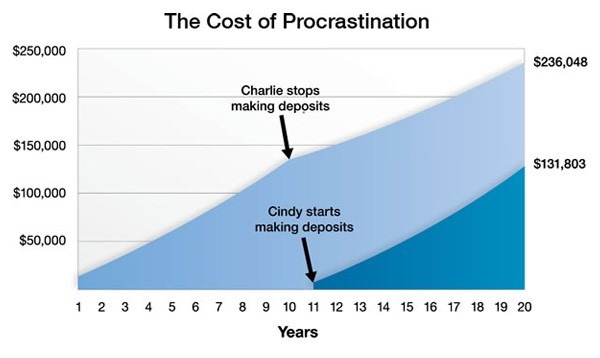
As the illustration below shows, putting off investing may put off potential returns.
If you have been meaning to get around to addressing some part of your financial future, maybe it's time to develop a strategy. Don't let procrastination keep you from pursuing your financial goals.
Early Bird
Let's look at the case of Cindy and Charlie, who each invest $100,000.
Charlie immediately begins depositing $10,000 a year in an account that earns a 6% rate of return. Then, after 10 years, he stops making deposits.
Cindy waits 10 years before getting started. She then starts to invest $10,000 a year for 10 years into an account that also earns a 6% rate of return.
Cindy and Charlie have both invested the same $100,000. However, Charlie's balance is higher at the end of 20 years because his account has more time for the investment returns to compound.
This is a hypothetical example of mathematical compounding. It’s used for comparison purposes only and is not intended to represent the past or future performance of any investment. Taxes and investment costs were not considered in this example. The results are not a guarantee of performance or specific investment advice. The rate of return on investments will vary over time, particularly for long-term investments. Investments that offer the potential for high returns also carry a high degree of risk. Actual returns will fluctuate. The type of strategies illustrated may not be suitable for everyone.
The content is developed from sources believed to be providing accurate information. The information in this material is not intended as tax or legal advice. It may not be used for the purpose of avoiding any federal tax penalties. Please consult legal or tax professionals for specific information regarding your individual situation. This material was developed and produced by FMG Suite to provide information on a topic that may be of interest. FMG Suite is not affiliated with the named broker-dealer, state- or SEC-registered investment advisory firm. The opinions expressed and material provided are for general information, and should not be considered a solicitation for the purchase or sale of any security. Copyright FMG Suite.
Advisory services are offered by Q2 Wealth Management, a Registered Investment Adviser. Insurance products are offered through Q2 Wealth Insurance, an affiliated insurance company. Investing always involves risk and possible loss of capital. Past performance is not indicative of future results.
This content is solely for informational purposes. Adviser believes that the content provided by third parties and/or linked content is reasonably reliable and does not contain untrue statements of material fact, or misleading information. This content may be dated. This communication shall in no way be construed or interpreted as a solicitation to sell or offer to sell advisory services to any residents other than those States in which Q2 is registered or where otherwise legally permitted. Q2 Wealth Management and Q2 Wealth Insurance are not affiliated with or endorsed by the Social Security Administration or any other government agency.
Advisory services and/or insurance products are only offered to clients or prospective clients where Q2, its affiliates, and/or its representatives are properly licensed or exempt from licensure. Investment adviser representatives of Q2 may only transact business in those states where they are registered or otherwise excluded or exempted from state registration requirements.
“Likes” are not intended to be endorsements of our firm, our advisers, or our services. Please be aware that while we monitor comments and “likes” left on this page, we do not endorse or necessarily share the same opinions expressed by site users. Please be aware that any form of testimony from current or past clients about their experience with our firm is strictly forbidden under current securities law. We request that you do not post or comment.
Third-party rankings and recognitions are no guarantee of future investment success and do not ensure that a client or prospective client will experience a higher level of performance or results. These ratings should not be construed as an endorsement of the advisor by any client nor are they representative of any one client's evaluation.
All expressions of opinion are subject to change without notice. All information herein is current as of the date and is subject to change without notice. Any views or opinions expressed may not reflect those of Q2. Charts, graphs, and formulas may be discussed and displayed which are not intended to be used by themselves to determine which securities to buy or sell, or when to buy or sell them. Such charts and graphs offer limited information and should not be used on their own to make investment decisions.
Q2 has a reasonable belief that this marketing does not include any false or materially misleading statements or omissions of facts regarding Q2’s services, investments, or client experiences. Q2 has a reasonable belief that the content as a whole will not cause an untrue or misleading implication regarding Q2’s services, investments, or client experiences.